
This lesson applies to all instruments, even guitar, violin and the like; not just the piano. The piano layout given, is just for us to be able to understand the arrangement of notes better visually.
In the previous lesson, we had seen what a major scale is. In this lesson let’s explore further and understand what a minor scale is.
There are many types of minor scales. The scope of this lesson is restricted to ‘Natural’ Minor Scale. We will be studying other types of minor scales in the next lesson.
There are two ways of deriving a natural minor scale; one is the absolute approach using the formula, and the other is a relative approach.
The formula of a natural minor scale is: _ T _ S _ T _ T _ S _ T _ T _ .
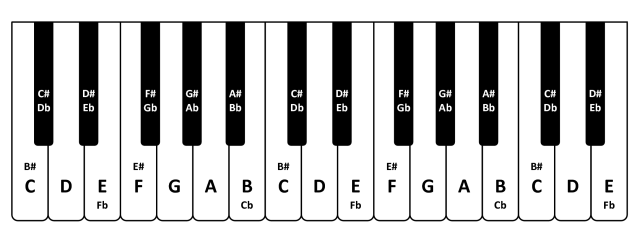
Let’s try constructing A Natural Minor scale using the formula: A T B S C T D T E S F T G T A.
We notice that A Minor scale is just the C Major Scale starting from the note of A. This brings us the the second approach, where we can derive a minor scale using another major scale.
We can get a minor scale starting from the 6th degree of a major scale. So if we count 6 notes from C in the scale of C Major, we land on A. And when we start the scale of C Major from the note of A, we get A Minor.
Conversely, we can get a major scale starting from the 3rd degree of a minor scale. So if we count 3 notes from A in the scale of A Minor, we land on C. And when we start the scale of A Minor from the note of C, we get C Major.
But what do C Major and A Minor have in common? They share the same notes; or in other words, they share the same key signature. They are called Relatives of each other. That is, C Major is the relative major of A Minor, and likewise, A Minor is the relative minor of C Major.
We will learn more about degrees, key signatures and relatives in the upcoming lessons.
If you find this lesson useful, please considering sharing with your friends and family so that they may benefit too. Please let us know your thoughts by giving your valuable feedback. Thank you!
 Yeshua Music School, since 2011