
This lesson applies to all instruments, even guitar, violin and the like; not just the piano. The piano layout given, is just for us to be able to understand the arrangement of notes better visually.
In the previous lesson we had studied what notes are and how to name them. In this lesson let us apply notes to understand scales. A scale is a sequence of notes that has a formula and obeys certain rules.
Scales can be categorised by the number of unique notes in it, like 5-note (pentatonic) scales, 6-note (hexatonic) scales, 7-note (heptatonic) scales, etc..
Let’s look at a type of heptatonic scale for our lesson, called a Major Scale.
The notes in a major scale are spaced as: _ T _ T _ S _ T _ T _ T _ S _ where ‘T’ stands for a Tone and ‘S’ stands for a Semitone.
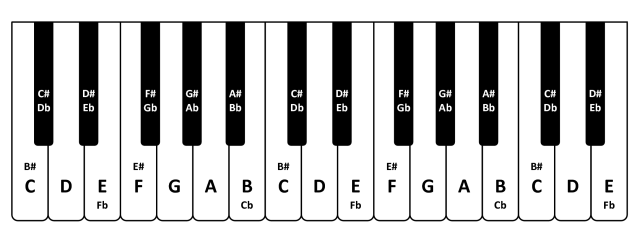
For example, C Major Scale can be derived using the formula, as follows: C T D T E S F T G T A T B S C.
Let’s see another example, G Major Scale can be derived using the formula, as follows: G T A T B S C T D T E T F♯ S G. We can observe that we get F♯, and not F.
Similarly, F Major Scale can be derived using the formula, as follows: F T G T A S B♭ T C T D T E S F. We can observe that we get B♭, and not B.
Now that we get the formula, we should also remember to use all the 7 alphabets in a major scale in the correct order; conversely, we cannot omit any of the 7 alphabets.
For example, let’s consider F♯ Major Scale – F♯ G♯ A♯ B C♯ D♯ F F♯ – this is incorrect as we have violated the rules; we shouldn’t repeat or omit any alphabet. Here, we see that we have repeated the alphabet F, thus omitting the alphabet E! The correct scale of F♯ Major would be – F♯ G♯ A♯ B C♯ D♯ E♯ F♯.
List of Major Scales:
0♯ 0♭ – this tells the number of ♯ or ♭ in the scale.
C Major
C D E F G A B C
1♯
G Major
G A B C D E F♯ G
2♯
D Major
D E F♯ G A B C♯ D
3♯
A Major
A B C♯ D E F♯ G♯ A
4♯
E Major
E F♯ G♯ A B C♯ D♯ E
5♯
B Major
B C♯ D♯ E F♯ G♯ A♯ B
6♯
F♯ Major
F♯ G♯ A♯ B C♯ D♯ E♯ F♯
7♯
C♯ Major
C♯ D♯ E♯ F♯ G♯ A♯ B♯ C♯
1♭
F Major
F G A B♭ C D E F
2♭
B♭ Major
B♭ C D E♭ F G A B♭
3♭
E♭ Major
E♭ F G A♭ B♭ C D E♭
4♭
A♭ Major
A♭ B♭ C D♭ E♭ F G A♭
5♭
D♭ Major
D♭ E♭ F G♭ A♭ B♭ C D♭
6♭
G♭ Major
G♭ A♭ B♭ C♭ D♭ E♭ F G♭
7♭
C♭ Major
C♭ D♭ E♭ F♭ G♭ A♭ B♭ C♭
We do have scales having more than 7 sharps or 7 flats. These scales use double sharps (𝄪) and double flats (𝄫) respectively. For example:
8♯
G♯ Major
G♯ A♯ B♯ C♯ D♯ E♯ F𝄪 G♯
8♭
F♭ Major
F♭ G♭ A♭ B𝄫 C♭ D♭ E♭ F♭
We observe that the scales having sharps do not have flats and vice versa.
If you find this lesson useful, please considering sharing with your friends and family so that they may benefit too. Please let us know your thoughts by giving your valuable feedback. Thank you!
 Yeshua Music School, since 2011