
This lesson applies to all instruments, even guitar, violin and the like; not just the piano. The piano layout given, is just for us to be able to understand the arrangement of notes better visually.
Notes are sounds with a name.
We name notes using the first 7 alphabets – A, B, C, D, E, F and G. However, there are more than just these 7 notes. The other notes are named using these 7 notes.
The steps between two notes are counted as Semitones and Tones.
- Semitone is a 1-note step.
- Tone is a 2-note step.
- Sharp (♯) is a semitone higher than the note.
- For example: C♯ – the note higher than C by 1 semitone.
- Flat (♭) is a semitone lower than the note.
- For example: E♭ – the note lower than E by 1 semitone.
- Double Sharp (𝄪) is a tone higher than the note.
- For example: F𝄪 – the note higher than F by 1 tone, that is, G.
- Double Flat (𝄫) is a tone lower than the note.
- For example: B𝄫 – the note lower than B by 1 tone, that is, A.
- Natural (♮) means the note is neither a sharp nor a flat. We will learn about this in the upcoming lessons.
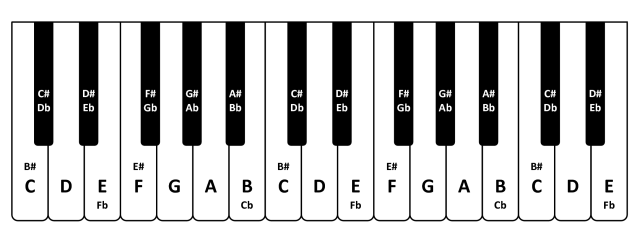
Coming back to semitones and tones, we now understand that C♯ is a semitone higher than C, and D♭ is a semitone lower than D, which means that the note in between C and D has 2 names – C♯ and D♭. However, when we can use the name C♯ and when we can use the name D♭, depends on the scale that we are in and other conditions, which we will be learning in the next lesson.
We can observe that all 7 alphabets do have sharps and flats. Notes such as E♯, F♭, B♯ and C♭ do exist, which means that sharps and flats are not exclusive to black keys. As a matter of fact, we can have 21 names for 12 distinct notes that use 7 alphabets, just by using sharps and flats. We can have a lot more using double sharps and double flats.
If you find this lesson useful, please considering sharing with your friends and family so that they may benefit too. Please let us know your thoughts by giving your valuable feedback. Thank you!
 Yeshua Music School, since 2011